Wednesday, July 20, 2011

I Need You

Robert Bunter: I'd make a serious case for this one as the best of the early George tracks. My man Harrison didn't really develop his own voice until about Revolver, so the yardstick by which I measure the early stuff is, how close does this come to the glory of a Lennon-McCartney song? "I Need You" goes a long way in that direction. It's got a beautiful mood (two lovers having a deep relationship discussion in the mellow sunset glow at the end of a melancholy Sunday in London) that is sustained nicely throughout the song. Of course, it wouldn't be an early Harrisong without some really clumsy lyrics. "[You] said you had a thing or two to tell me / How was I to know you would upset me?" anyone? He uses two words that don't rhyme ("tell" and "upset"), but he figures it's okay because he just repeats the word "me" in both lines. And do you know what? It is okay. It's completely fine. I'm not going to sit here and pick nits when I could just bask in the wonderfulness that is George Harrison's 1965 track I Need You. Richard?

Richard Furnstein: Harrison the prize fighter heads back in the ring with "I Need You." He's still in the welterweight division, but is no longer suffering humiliating losses such as "I'm Happy Just To Dance With You" and "You Know What To Do." This track from Help! suggests that Harison is slowly working his way up the ranks; delights such as "If I Needed Someone" and "Love You To" are right around the corner. "I Need You" is still a bit unformed and ugly (the uneven volume pedal touches that disrupted the contemporary recording "Yes It Is" and the cowbell and moan bridge that attempts to cover up George's inability to significantly vary the melodic range), but fits well along with the awkward pre-Rubber Soul efforts from John and Paul.

Meanwhile, John, high on marijuana, gives it the old pump-and-
strum on his Guild Jumbo and moans nicely on the background harmonies.

Robert Bunter: Let's take a glance at the musical arrangement. Ringo keeps it simple and steady, with a little added percussion on the bridge (cowbell? claves?) for emphasis. Paul is admirably restrained on the bass, sticking to the roots and fifths. In years to come, George would complain about Paul's busy basslines on tracks like Something, but of course we know that he was just being bitchy because McCartney didn't want him playing stupid call-and-response guitar lines after every stanza of Hey Jude, which would have been really obnoxious and I have to say Paul was right in that case. But here, Paul gives him nothing to complain about. "I'll just keep it simple, OK, George? In fact, I can hardly be bothered to contribute to this thing at all, because I treat you as a second-rate talent and belittle your contributions. It's nice that you have written a song called I Need You based on that stupid D-chord thing where you wiggle your pinky around on the E-string which sounds like something I might have tossed off in 1963. You'll have to excuse me, I need to go get ready to record "Yesterday," "I'm Down," and "I've Just Seen A Face" in one single session. Yes, George, I'm telling the truth." That really did happen. Meanwhile, John, high on marijuana, gives it the old pump-and-strum on his Guild Jumbo and moans nicely on the background harmonies. And in the center of the stage is George Harrison, singing earnestly and doing that volume-swell trick with the guitar knob. Sure, it's not as revolutionary as Lennon inventing feedback or McCartney bringing in a string quartet, but what do you expect from the least talented of the three main Beatles?

Richard Furnstein: Self righteous moaning? Musically tedious drones? Uneven teeth? Curry stained fingertips?

Just kidding, Dark Horse 4EVA. R.I.P., George. We will never forget you.

Thursday, July 14, 2011

Because

Robert Bunter: One thing I really like about this song, besides the fact that it's like sweet audio butter that melts deliciously in my brainpan, is that it represents the Beatles just being Beatles (circa 1969) the very best they could. They weren't parodying the music of another era ("Oh, Darling!," "Maxwell's Silver Hammer") or writing about themselves ("You Never Give Me Your Money," "I Want You (She's So Heavy)". It's just some vintage cosmic Lennon wordplay, sweetened with some vintage beautiful McCartney/Harrison harmonies, buoyed by some vintage harpsichords, topped with some vintage primal Moog synthesizer tones.

Richard Furnstein: That's a great point. "Because" is The Beatles at their most sophisticated. It's a gorgeous and classical song with very modern touches (the aforementioned Moog) and an unusual progressive feel. The story goes that Yoko was playing Beethoven's "Moonlight Sonata" on the piano (don't be so shocked; she went to Sarah Lawrence and came from money). John heard the C#m lurch and requested that she play the chord sequence backwards. It's not just a good story, it's an effective metaphor for the unusual sound of this song. The chords go backwards--and yet point to the future. Like a time traveler crashing his jalopy of a vessel into a Victorian garden. It's the twee "throw back the clock" promise of Sgt. Pepper's realized without the garish psychedelic dressing.

Robert Bunter: One thing this song is missing: Ringo! I can imagine him adding a sweet spoken passage, a la Good Night. It would be during the synthesizer solo, and he would say this: "Who knows why the world is round? Wot if a tree fell in the woods and no one was there to listen? Wot if they gave a war and nobody came? Things are more like they are now than they’ve ever been before. It's one of the many mysteries of the cosmic universe" or something like that, in his inimitable Liverpool accent.

That’s a great point. Wait: no, it isn’t.

Richard Furnstein: The message of "Because" is clear: Love is timeless: it's a finely tailored suit embracing raw emotion. An orphaned working class British child can have his world changed by an avant Japanese lady who cares more about screams and liberal arts fartery than Chuck Berry riffery.

Robert Bunter: That’s a great point. Wait: no, it isn’t. I’m not sure what one thing has to do with the other. But still – this is a great example of Lennon’s beautiful, dreamy side. His wit and cleverness are ever-present, yet baby-simple. He’s gazing at the slowly revolving reference frames of our ever-shifting natural world (spinning globe, blue skies, high winds) through the dazed, narcotized eyes of a sleepy, smiling infant who’s been fed one of those morphine-laced teething formulas that they used to give to babies in 1911 before they realized how harmful that was.

Richard Furnstein: Speaking of harmful: how about the complete shift in the musical understanding of this song following the Anthology alternate mix? Anthology provided a gorgeous acapella version of this song, which highlighted the angelic voices of our snarl-toothed heroes while forsaking the minor key tension and innovative arrangements that truly elevated the recording. Two vocal only versions emerged after the Anthology version: an Elliot Smith cover in The Royal Tenenbaums and the opening birds in the reverb tank version that opened the underrated Love stage production soundtrack. Hey, I love the voices of John, George, and Paul more than anyone else, but let's not forget that a weird and beautiful song lives underneath those suspended vocals.

Robert Bunter: I have nothing to add. Another triumph!

Wednesday, June 29, 2011

Only A Northern Song: Part 3-They Just Play It Like That

Robert Bunter: This song was originally recorded during the anything-goes experimental era of the Sgt. Pepper sessions, hence the unorthodox recording technique: George recorded seven tracks on two separate four-track machines, leaving one track free for a metronome click so they could synchronize them. What a brilliant idea! "I guess you could say we invented eight-track recording!" The problem became apparent when it was time to mix the thing. Nobody could get both of the machines to start playback at the exact same time. They'd have two people hit the play button, but it would never come out exactly right. I can just imagine those sessions! Paul was probably going on and on about how this would revolutionize the industry, and how he might later take credit for it. John was imagining the ability to overdub even more formless shrieking onto tracks like "What's The New Mary Jane." Ringo was eating beans and "crisps" while George was meditating in the corner but actually he was thinking about how he would like to sleep with Ringo's wife Maureen, which he finally wound up doing in the 1970s. But after listening to Geoff Emerick and George Martin try and fail for the umpteenth time to start the machines simultaneously, they began to get disgusted. They were not very patient when it came to things like that. They probably called for their driver to come pick them up and take them to the Bag 'O Nails club where they sat with Keith Moon and Mama Cass and talked about hallucinations.

Richard Furnstein: It's odd that they chose this half-written crapfest to test their technological limitations. They managed the supreme piece of recording art that is "Strawberry Fields Forever" with a four track, but thought that they needed twice as much recording capabilities for George's moaning waif of a song. I'm surprised they didn't insist on a 48 track mixing board when they started work on "Don't Pass Me By." The Beatles are the greatest thing that humans have ever accomplished, but they certainly didn't understand the concept of "you can't polish a turd." The Fab Four (along with Chief Turd Polisher George Martin and Admiral Turd Buffer Geoff Emerick) would routinely try to make something from nothing. Sometimes it was pure bliss (cue "You Know My Name Look Up The Number") and other times you had to sit through endless vomit like "All Together Now" or "Only A Northern Song." The psychedelic years saw the biggest offenders of this trend, as a few toots of a horn or a backwards calliope were all that were needed to legitimize the lamest of acid-fueled half-ideas.

Robert Bunter: Everybody finally gave up and let this song onto the Yellow Submarine 1969 soundtrack album in a hideous "fake stereo" mix (highs on one channel, lows on the other), but it's surprising they didn't just release it in the horrible out-of-synch version they must have heard in the studio when they didn't hit the buttons at the same time. That would have been in keeping with the violent assault which this song represents.
The Fab Four (along with Chief Turd Polisher George Martin and Admiral Turd Buffer Geoff Emerick) would routinely try to make something from nothing.

Richard Furnstein: "Only A Northern Song" was originally slated to appear between "Fixing A Hole" and "Being For The Benefit Of Mr Kite" on Sgt. Pepper's. Can you imagine if this actually happened? I don't need to imagine, I pressed a small run of Sgt. Pepper's original tracklists for my personal use in 1983. And take it from me, it's an absolute mess. You are barely coming down from the supremely incredible "Fixing A Hole" (remember: gentle fade) and the death chords of "Only A Northern Song" come blaring. Then you have to deal with John's fey psychedelia in "Mr. Kite," all the while wondering why you didn't just lift the needle during the perfect "Hole" fade. You are sitting there, completely not under the influence of acid, listening to some overblown handlebar mustache psyche-ooze. Oh, wise guy, think you'll just make an MP3 playlist in your iTunes? Great idea, but you don't even have the relief of an album side change to give you a break from the dreaded black hole of "Northern Song"->"Mr. Kite"->"Within You." It's a John babble sandwich with two thick overlong pieces of moldy George Harrison fumbling songwriter bread. Choke it down, fool. That's what you get for messing with perfection.

Tuesday, June 28, 2011

Only A Northern Song: Part 2-The Chords Are Going Wrong

Robert Bunter: The musical accompaniment of "Only A Northern Song" illustrates and enhances the lyric's description of a slightly-askew song performed by an absent band. Paul's bassline bobs and struts deftly as always, but he doesn't always change chords when the rest of the song does. The piccolo trumpets which soared so delicately above "Penny Lane" are stuttering and squealing discordantly. The tape loops that transformed "Tomorrow Never Knows" into a psychedelic mind trip are here, but they are deployed in the service of pure confusion rather than novelty and shock. The goofy voices of "Yellow Submarine" are in the background, but they're moaning strangely and mumbling "Heavy, heavy." The organ introduces the song with a churchy, strange sort of major sixth chord which has nothing to do with the tonality of the rest of the song, before funkily resolving down to a full major chord which seems to fix the listener with an evil, bared-teeth grin and bloodshot, demented horse-eyes. The guitars ... what guitars? There's no guitars.

Richard Furnstein: A chill sets in the room. A funereal organ pushes out of every speaker, turning the desert landscape orange and then purple. The cacti are bleeding just as the sand trickles and moves towards some hidden drain. And all this before the drums kick in. It's a blast towards outer space. Constellations flicker and blur into a black sky. The singer is a headless aura, a suggestion of self. It doesn't really matter what form he takes, his voice only makes the night sky darker and more impossible to navigate. It's an unpleasant feeling, my blood runs light up here. DON'T ASK ME HOW I KNOW THAT.

Robert Bunter: I'm not comfortable with the way this is going, Richard.

The actual Beatles, who you thought were your beloved friends and advisers, are four dark men you will never meet and who regard you with barely-concealed contempt.

Richard Furnstein: This place isn't meant to make you comfortable. You are barely emerging from the clouds of a few potent segments and your childhood home is full of activity, mirth and movement. You advance from your room, where the striped wall paper seemed to be finding new vanishing points. The hallway appears vacant, but a bustling horn band creeps from underneath your sister's bedroom door. It's Sunday on BBC 1, but the hallway sends the galloping trumpet into a simultaneous reverse and forward motion. The Salvation Army band feeds like a music box; magenta twirls cough out as the tuba player is caught in the spokes. Mother's room is at the end of the hall; and there is talking come from the room. That man's voice isn't your father's; and his booming voice suggests a substantial mustache. Retreat. Run down the stairs: five to the first flight, turn left, four more, left again, the final four. You bound onto the wooden floor, just as you did as a 9 year old. Yet, you are much older, this is your childhood home and it is full of spirits and men and sounds that you have never heard or expected. You'd run out the front door and follow the grid to the woods, but the front door isn't there.

Robert Bunter: Here's something I don't like: George double-tracks his voice in unison through the entire song, except for the word "brown" on the line "if my hair is brown." Why the emphasis on that word? It's equally disquieting when he says "You're CORRECT," with what sounds like sadistic emphasis. You were sitting there in stuporous stoned rapture, watching the four Beatles chop and thump their way through another psychedelic dreamworld, when suddenly the George-figure looks directly at you and says, "If you think the harmony / is a little dark and out-of-key / you're CORRECT" and at the same time he takes off his face-plate, revealing the hideous snapping mechanical works that were underneath there the whole time and you sort of suspected it but kept nervously pushing that thought to the back of your mind because of the terrifying implications. The wonderful men who sang about "She Loves You" and "Good Day Sunshine" and "Getting Better" were actually disembodied electrical impulses etched violently into black polyvinyl choloride and decoded by your pitifully inadequate home audio equipment. The actual Beatles, who you thought were your beloved friends and advisers, are four dark men you will never meet and who regard you with barely-concealed contempt.

Monday, June 27, 2011

Only A Northern Song: Part 1-I Told You There's No One There

Richard Furnstein: Originally recorded for Sgt. Pepper's Lonely Hearts Club Band, "Only A Northern Song" manages to be at once an effortless bit of psychedelic filler (as the title cooly states) and a harrowing soundscape of the changing vistas of pop music. George Harrison, irked that his songwriting efforts were published under Lennon and McCartney's Northern Songs Ltd. umbrella, tossed off "Only A Northern Song" as just that--contractual filler in which the harmonies, lyrics, and chords were secondary to the contractual and financial advancement of the Beatles' songwriting craft.

Robert Bunter: This is one of the most terrifying songs in the catalog. The startling fact that it ended up on the Yellow Submarine soundtrack LP, presumably aimed at young children, qualifies as pure abuse. The little kiddies had so much fun in the theater, watching Old Fred and the charming Beatle lads defend Pepperland from the Blue Meanies. Then they talked their mum and pap into purchasing a copy of the cartoon-adorned LP at Gloanburg's Shilling and Pence. They took it home and were ready to enjoy the goofy-voiced charms of "Yellow Submarine" and "All Together Now." Suddenly, a nightmare organ opens a creaky door into a harrowing, discordant world where the thick voice of creepy Harrison starts addressing them DIRECTLY, confronting the unformed child's mind with the stark reality of what they're doing: listening to a horrible Beatles song. Bleak trumpets and strange echoing little toy noises assault the ear as the grammatically-fractured lyrics torture the mind. Stop! I'm not ready for this. I'm an eight-year-old child! I'm going to have nightmares about this experience. I didn't know music could talk at you.

Richard Furnstein: It's generally fun jabberwocky (well, as much fun as can be had at this dreadful pace) defined by wordplay and dismissive accounts of what makes a song. Well, that is until George removes the furniture from the room as the sound effects begin to envelop the languid backing track as the lyrics "And I told you is no one there" suggests circuitry and patterns have overtaken the songwriting process. Music lacking emotion, the ultimate trip. Syd Barrett would pursue similar themes in his contemporary recording "Bike" (from The Pink Floyd's Piper At The Gates Of Dawn). Barrett describes a host of physical objects (the titular bike, a mouse, a cloak, gingerbread men) that are physically manifestations of his lifestyle (and ultimately his love). The creature comforts are dramatically removed in the final verse where Barrett describes a "room of musical tunes" that create sounds like "clockwork." Again, the mechanical and artificial is the final stage of psychedelia. The bevy of sound effects and tape manipulations become a process; even Ringo's drums are now a slave to a recording process. The rock is dead and the machines are taking over. It's only a song that you request? Let's dial up the machinery, love!

Music lacking emotion, the ultimate trip.


Robert Bunter: This was George's "Glass Onion." Again, both songs directly address the reality of the relationship between a Beatles' record and its listener, in a tone that is markedly sardonic and confrontational. In these lyrics, John and George, minds clouded by boutique-pedigree acid, behold their fans. In three or four short years, they've watched them morph from hysterical 13-year-old girls to pimply, stoned teenagers with dead eyes and dumb thoughts. There's no way to communicate with these mental cripples. Let's just spit on them. After you play these tracks, you have to wipe the Beatlespit off your face. Just sit there and think about how dumb you are. We hate you. The idea that someone might have listened to this song while taking cheap, adulterated street acid is enough to make your imagination hurt. The organ intro alone is making me want to pull out one of my eyes so I can turn it around and stare into the other one. My mind is dead.

Richard Furnstein: "Signed Curtain" by Matching Mole is the atomic fallout of the takeover of the machines. Robert Wyatt's aching voice delivers a beautiful melody over rote piano chords. "This is the first verse" the lyrics tell us. Logically, they later tell us the emergence of the bridge, key changes, and "another part of the song." "Signed Curtain" takes the concept of emotionally resigned songwriting to its naked conclusion. The humans have long since left the room. The machinery has rusted or shut down. The only remaining element is raw awareness of self and the futile nature of artistic expression. It's a harrowing journey, and one that starts with some throwaway track from the Yellow Submarine album of filler and George Martin orchestration. Don't let Paul or Ringo see this, they may just claim that they invented meta songwriting. You know, the same way they invented MTV, house music, recording guitar feedback, Ozzy Osbourne, and casual sex.

Wednesday, June 22, 2011

Hello Goodbye

Robert Bunter: James Paul McCartney's gifts as a composer and performer are vibrantly displayed here. An effortless sense of joy just leaps out of the speakers and makes you want to smile. There are those who criticise the relatively lightweight insignifigance of the lyrics (paired with "I Am The Walrus" on a 1967 single, it's one of the most obvious examples of the contrasting songwriting personae of John and Paul), but I say they're missing the point. This is a song for children, senior citizens, people from other countries and hippies, as well as normal adults. Simple words, simple thoughts and a melody that seems like it was already written, just waiting for Paul to pluck it out of the air and give it a fantastic studio arrangement with organs, fiddles and one of those percussion shaker things.

Richard Furnstein: "Hello Goodbye" is perhaps the best example of the complete superiority of Lennon and McCartney as songwriters, the Beatles as performers, and George Martin as a producer. Paul essentially delivers a 1910 Fruitgum Company song (complete with "Simon Says" nursery rhyme lyrics) and a perfect bubblegum melody. The difference here is the little touches. George Harrison is the absolute star of the show here, his backing vocals exemplify the psychedelic backing vocal sound of the time and his guitar touches such as climbing the major scale and a lovely descending figure are absolute gorgeous. "Hello Goodbye" is one of the perfect productions in their catalog and I will go to my deathgrave defending its perfect beauty.

Robert Bunter: Truly, we can all celebrate what Paul was doing here. He's speaking directly to the heart. Spare us your inscrutable riddles and acidhead nightmares, John - we're having a pleasant celebration on Paul's side of the record. Surprisingly, I will make the exact opposite point when we finally get around to examining "I Am The Walrus," one of Lennon's purest artistic triumphs.


It's all candy, they tell us. The colours are there to delight.
Richard Furnstein: Bubblegum music is a beautiful thing, and the Beatles did a lot to add to the art form ("She Loves You" as the shining triumph of the genre). "Hello Goodbye" is an attempt to channel the disposable pop song into a perfect piece of art. Check the promotional clip for "Hello Goodbye," the lads are having great fun (despite the uncertainty that they were facing the death of Brian Epstein and the future psychodrama of the White Album), even playing with their previous moptop image and referencing Elvis Presley's hip shaking. It's all candy, they tell us. Grab every shining nugget in the bowl, children. The colours are there to delight.

Robert Bunter: Paul was the one with the most consciousness of world music. From the Latin flavors of “Step Inside Love” and “Los Paranoias” to the later flirtations with reggae (“C Moon,” “Jet,”) and non-specific exoticism (“Mamunia,” “Kreen Akore,” “Loup (1st Indian On The Moon)”), it was McCartney who was quickest to exploit the groovy sounds and rhythms of faraway cultures. The trick ending on “Hello Goodbye” is a nice example of this tendency. It functions a bit like the gospel explosion at the end of “Ticket To Ride” – the singers and band top everything off by throwing back their heads and shouting with joyful abandon. Better get your passport stamped! Suntanned Paul is ready to greet you with a lei as you disembark from a jet airplane called music. Next stop: Pepperland!

Tuesday, June 21, 2011

Carry That Weight

Richard Furnstein: Without a doubt, the lightest of the lightweights in the Abbey Road medley. "Carry That Weight" is not much more than Ringo bellowing in the cavernous Abbey Road studios and some lovely callbacks to the momentous "You Never Give Me Your Money." It's a reassuring final sprint for the boys; reminding us once again that they were human beings all along. Ringo's tone deaf shouting lent a similar everyman sheen to art house numbers like "The Continuing Story of Bungalow Bill," "Flying," and "You Know My Name Look Up The Number." "Carry That Weight" is his final shout in his Beatles costume, following this moment he would ascend to the heavens during his rapturous drum solo in "The End."

Robert Bunter: Lightweight? This song weighs a ton. You do realize that this is the sound of the Beatles confronting their impending breakup and the knowledge that the rest of their lives will be defined by the enormity of what they'd accomplished over the past ten years or so, right? How do you think it felt to be in that studio, shouting along with Ringo on what they just knew was going to be their last hurrah? I'll tell you how it felt: they were crying. John looked over at George and there were tears rolling down his face. That made John start to well up, and then he looked over at Paul and remembered the first time they met at the Woolton fete. Paul was just singing, not really crying, but then he looked up from the microphone and remembered the time he and Ringo stayed up all night talking in Rishikesh, and thought about how the whole thing was going down the pan and they were breaking up. George Burns was there, too. He was holding a top hat to his chest and trying to keep from weeping. I have the footage.


How do you think it felt to be in that studio, shouting along with Ringo on what they just knew was going to be their last hurrah? I'll tell you how it felt: they were crying.
Richard Furnstein: Fair enough! I just meant that there's not much to the song. All the cool bits are from that other song. But, sure, this band went from crusin' for some sweet hand holding to reflecting on how they devoted their twenties to dramatically shifting cultural and artistic trends. It's like Paul knew that he was facing the next lifetime alone. No more John to carry the burden of lean years (London Town). No more George to lend sweet harmonies and licks to every little thought that he put on tape (he'd have to keep Denny Laine on salary for the next ten years for that). No more Ringo to trumpet the childlike innocence that fueled their creative process. A dark road laid ahead, filled with triumphs, missteps, McCartney/Starr co-writes, breast cancer, assassinations, synthesizers, and Nigel Godrich productions. Can you carry that weight? Well, dig in, brother. It's coming.

Robert Bunter: McCartney/Starr co-writes? Huh? (shakes head in startled disbelief and makes cartoonish "e-yada-yada-yada" noise) Do mine ears bewitch me? Hold on a minute, I'm going to consult the computer about this. [...] I don't see anything. You made that up, right? Please tell me there aren't really any McCartney/Starr co-writes.

Richard Furnstein: Hold on to your butt! No, seriously, hold your butt closed. Poop is going to escape your body when you hear this song.

Robert Bunter: That song makes Wild Life sound like Band On The Run!

Thursday, June 16, 2011

Don't Pass Me By

Robert Bunter: Oh GHOD, do we really have to sit here and listen to this turd? Hands down, the worst song in the Beatles' illustrious catalog. It makes "What's The New Mary Jane" sound like "You Won't See Me" or some shit. Did you read in the Anthology book where Ringo talks about how he wrote this? "The White Album was really great for me ... I wrote my first song! I just know a few chords, so I sat there and played ... a few tokes later, I had the track! It was great doing the recording session with that crazy fiddler!" That's an exact quote. Maybe it didn't occur to him that he would be stinking up one of the Beatles' greatest albums, which I like to call: "The Beatles." It would have been better if he'd just sang one of his goddamn insufferable Carl Perkins covers, like in the good old days. Two thumbs down for the nadir of 1968.

Richard Furnstein: Whoa, back up the truck. I mean, hit the stop brakes, feel the dust kick up around you, take a look in the rearview for safety, quickly reverse down the middle of Areyoushittingme Street. Better yet, look at yourself in the mirror. Is there a gaping, festering hole where a normal human sized brain would be? Because I'm putting this top tier of the 30 song marathon (jog don't run) of The Beatles. It's not just a pity tug, I genuinely believe in the power of this one.

Robert Bunter: Listen, I don't say things like all that stuff I just said lightly. I gave it quite a bit of thought. I suppose your going to make one of your typical arguments by going on about how much you love the vintage analog compression on the crash cymbal. I'm just going to go ahead and list the things this song lacks: charm, wit, musical interest, social commentary and a justification for placement alongside such masterpieces as "Sexy Sadie" and "Mother Nature's Son." C'mon, you're not going to lie and tell me you enjoy listening to this trash. It's me, Richard. C'mon.

Richard Furnstein: I do genuinely enjoy it, and here's why: it's Ringo's coming out party. He was kicking around the basic idea for "Don't Pass Me By" since the days of finely pressed suits. Then it may have found its roots in Ringo's early role as the new boy, the drummer that could be replaced easily. Years of personality (and impressive drumming) seemingly placed him as an equal in the Beatles, but the making of the White Album seemed to disrupt the "all for one" vibe of albums like Revolver and Rubber Soul. Let's be frank: Paul was a better drummer (drool over the perfect drumming on "Dear Prudence"), George was only beginning to address his emotional scarring from years of playing the undercard, and John was increasingly detached from his oldest chums. "Don't Pass Me By" is Ringo clanging his salad fork against the fine china, while telling the table how it will be. We're moving forward together, fellas. This isn't up for discussion. Oh, and I wrote a song. It's making the double album, it would make the single album, and because it's a Starkey Songs original, it'll carry more historical significance than a basketful of "Julias," "Honey Pies," and "Glass Onions." Deal with it.

Ringo's coming out party stinks.


Robert Bunter: Ringo's coming out party stinks. He came out, then he wrote "Octopus' Garden," then the party was over. Now it's time for a bunch of lousy Richard Perry productions, tours with Peter Frampton and poor fashion choices in the Anthology videos. Listen, I love Ringo. He's the greatest, and I'm glad he got a song on the album. The publishing royalties were probably very helpful when he needed to purchase cocaine and brandy in the 1970s. Let me reiterate: I love all the Beatles, especially Ringo Starr. Most of all.

Richard Furnstein: Cool, well, I'm glad we agree on our love of Ringo Starr. The Luckiest Beatle manages some fun little moments on this recording. Yes, the drum sound is enough to carry the flimsiest of songs (and the tune does indeed test the limits), Ringo howls with an appropriate level of anguish in his voice, and the manic fiddle (the mono mix is again essential) is aiming for country but winds up as an unusual C&W, raga, drugged out English genius amalgam). Great fun, and let's give Ringo a hand for the "You were in a car crash/And you lost your hair" line. Have fun with it, Ringo. Everyone is staring at you now, dazzle 'em!

Wednesday, June 15, 2011

I'm Only Sleeping

Richard Furnstein: Notorious lazy bones John Ono Winston Lennon continues his descent into self important "life-as-songwriting" with "I'm Only Sleeping." Using the template of "Help!," John writes what he knows (self-loathing and drug-induced stupors). It's a trick he would continue through the Sgt. Pepper era, only the promises of Eastern mysticism and Yoko Ono's progressive caterwauling would push Lennon's creative output to adopt the imagination displayed in his early short stories.


We could all learn a thing or two from this overweight, emotionally-stunted drug abuser when it comes to things like how we should stay in bed all day, or how easy it is to ignore your wife and child.
Robert Bunter: Hey, who wants to take a nap? ME! The great John Lennon penned a wonderful ode to sleeping and I find it simply wonderful. I think this is one that everybody can relate to. The chord changes have just a hint of Motown, but the sleepy acoustic strumming and yawning backwards guitars were pure Beatles. This is a true highlight of the "Yesterday And Today" album.

Richard Furnstein: It's pretty neat that George Harrison, he of superior teeth and slightly above normal intelligence, managed to complete define the backwards guitar solo in this early man attempt at studio trickery. Imagine that: "Shall we flip the tape for the solo?" Sure, says George, then he continues to draw a map away from the treasure (pop music perfection) to the startpoint (coordinates that I like to call innovation and inspiration). And he draws the damned map in perfect handwriting. Listen to that guitar solo. Don't forget to hang onto your butts in the process!


Robert Bunter: This is a song that shows the influence of drugs. John is tired because he's spent most of the past five years running around like a lunatic, and also because he's smoking reefers every two seconds. He's just saying: hey, don't wake me up. But in a deeper sense, isn't he also criticising all of us as we scurry through our drab nine-to-five routines? We could all learn a thing or two from this overweight, emotionally-stunted drug abuser when it comes to things like how we should stay in bed all day, or how easy it is to ignore your wife and child. Later, he would write "Rain" which explains how dumb we are for trying not to get wet from the rain. He's just so advanced and we need to start taking the hint.

Richard Furnstein: I got a head start by napping during your verbose and confused interpretation of this pop song. Great job!

Thursday, June 9, 2011

Dig It

Richard Furnstein: This aimless jam fades in and fades out, the ultimate sign of a lack of cohesion or direction. A snake eating itself. Imagine it's the year 2011 (which it is) and the Beatles are still there in cold Twickenham studios running through a list of things to "dig." Can you imagine that complete recording? It would be a fascinating look at the people, agencies, and social constructions of the times.

Back to the song, it's at once the worst recoding on Let It Be and the greatest representation of the Beatles at this time. Lennon takes the lead because he's an egomaniac and you get the idea that full band jams can only originate from him. I'm sure if George tried to lead the band through "Thanks For The Pepperoni" or some other garbage, John would just sit there, twiddling on his Fender VI or berating his Japanese wife or writing nasty reply letters to Todd Rundgren in the NME. And can you imagine a jam with just George, Paul, and Ringo? Sure you can, it would be great and I would covet that early generation bootleg with all of my soul.


Robert Bunter: Oh, yeah. I'd forgotten that I was talking to my friend Richard Furnstein, who doesn't like the Beatles' album Let It Be. I guess I should take this opportunity to explain that the Beatles, a singing group from Liverpool, decided to make an album that would reflect a natural, unvarnished presentation. The idea was to include random noodling, studio chatter, excerpts from aimless jams and a bare-bones production style as the framework to offer such magnificent gems as "Two Of Us," "Dig A Pony," and "I've Got A Feeling." Part of that effort was this song called Dig It, which was excerpted from a much longer track. It helps to foster the impression that you're peeking behind the curtain, hearing your favorite band in their candid moments. Plus, it's got a nice chugging groove (thanks, Billy Preston! Richard, Billy Preston was a man who helped the Beatles in early 1969, FYI) and some goofily inspired off-the-cuff ranting from a great vocalist who I like to call John Lennon. There's certainly nothing wrong with this song!

Richard Furnstein: Thanks, Robert. I appreciate the sarcastic instruction on the Beatles. I was simply stating that the "peek behind the curtain" was probably the closest representation to the raw Get Back concept. You can't have the beautify of "Let It Be" or "Dig A Pony" without the voyage on the dirt roads of rock n' roll. "Lookin' for 'Don't Let Me Down," guv'ner? Best drive straight through some incoherent jams on "Mailman, Bring Me No More Blues." You know, the Get Back album, right, Robert? Didn't you beg me for a cassette dub of my freshly purchased pristine early generation vinyl at Beatlefest 1993? I remember you said you would buy your own but you were saving up for a Sega Genesis or some garbage Frank Zappa rarities collection.

Robert Bunter: I don't remember any of that. So what is your point? The Get Back/Let It Be gems are strewn haphazardly amongst various crappy rock and roll jams? Thanks for the bracing insight, I didn't realize I was talking to Nicholas Schaffner over here. Criticising Dig It for being pointless and tossed off is like criticising Tony Danza for being a talentless oaf - sure, it's true, but that's the whole idea. If it were up to you, a prime specimen of charming lowbrow trash like "Who's The Boss" would have had tried for the polished look and feel of a class series like "Highway To Heaven" or "Father Dowling Mysteries." Sometimes "aimless and tossed off" is just what the doctor ordered. Can you "dig it?"

Richard Furnstein: When I think of your grave, all I want to do is "dig it."

Wednesday, June 8, 2011

Across The Universe (World Wildlife Fund Version)

Richard Furnstein: Good morning, the Beatles. Let's open the curtains, it's a lovely day. Some flapping birds and maybe a frog jumping into a crick. Wait, who is that cosmic specter at the window? John Lennon? The National Health glasses seem to tell the tale. And he's singing a song and it is WEIRD.

Robert Bunter: John Lennon's spirit was a collection of contradictions, taken to the farthest extremes. The same wracked, tortured freak who upset everybody with “I Am The Walrus,” “Yer Blues,” and “Revolution 9” is equally likely to calm us all down with a blissful, gauzy dreamscape like “Across The Universe.” I really love it! This is a beautiful mood that we can all get into.

Richard Furnstein: The World Wildlife Fund version of "Across The Universe" strips away the Phil Spector molasses to get down to the essentials (if you choose to ignore the cheap sound effects and squawking female backing vocals, which I suggest you do). There's a lot to enjoy in this song, meandering Lennon poetry (initially inspired by Cynthia Lennon's nagging), half baked spiritualism, and a gliding acoustic guitar that matches the cloudy brained lyric.

Robert Bunter: People don’t usually mention this one in the same breath with the heavy Lennon classics like “Strawberry Fields” and “A Day In The Life,” but it belongs there. I think it’s a major achievement. Lennon reportedly felt slighted by McCartney’s production ideas (basically, “Let’s do it really loose and sloppy, with a second-rate vocal track and then we’ll bring in some random girls to squawk on top of it, OK?”), but what does that have to do with anything? Was John so blissed out and lethargic that he didn’t have the gumption to insist on a higher-quality production concept? It was probably one of those passive-aggressive, poor communication things. Smiling Paul with his loose, anything-goes recording philosophy (except you’ll notice he was never quite so experimental when it was time to do something like “Hey Jude” or “Hello, Goodbye”) meets heavy-lidded, inscrutable John who is off on a cloud and just waiting for the group to break up anyway so that he can get on with his inferior post-Beatle life.

Richard Furnstein: An inferior life that included lots of squawking girl vocals and dodgy mantras (Ah! böwakawa poussé, poussé).

Robert Bunter: But that’s not all. You’ve got surly, pimply George with his dusky complexion and second-rate moustache sitting in a lotus position in the corner, just reeking of bad vibes. And then there’s Ringo, whose benign attitude and hangdog mug masked even greater insecurities. You can just sit there, Ringo. No drums on this one. Plus, a disgusted George Martin behind the producer’s glass window, frowning at this group of talented yet emotionally immature young men who were in the process of throwing away their greatest gifts because they couldn’t apply the messages they sang about so beautifully (love, peace, harmony, communication) to their own dysfunctional lives. The next thing that happened was, John got his revenge on Paul by adding the shoddy phasing effects to the mono mix of Your Mother Should Know. Everything goes in cycles. That’s what’s happening here.

Richard Furnstein: Your timeline is off and I don’t appreciate that cruel speculation. You know my thoughts on the mono mix of “Your Mother Should Know.”

Friday, May 27, 2011

You Can't Do That

Richard Furnstein: Hmmmm, maybe "You Can't Do That" isn't the best example of the influence of girl groups on songwriting of the early Beatles (especially Lennon). The song is decidedly "anti-girl," perhaps one of the most misogynistic lyrics in Lennon's resume. "I've got something to say that might cause you pain"/"I'm gonna let you down and leave you flat." These lyrics sing nicely (classic early Lennon monosyllabic meter) but suggest actual physical violence if the girl in the lyric continues to actually flirt with other men or any other actions that feed into Lennon's irrational jealous mind ("I can't help my feelings, I go out of my mind").

The title of the song says it all: "You Can't Do That." Not, "I Wish You Wouldn't Do That" or "That Really Hurts Me." Lennon lays down the law, and the judge, the jury, and the executioner seem to be incapable of making rational decisions. Run for your life, indeed.
Robert Bunter: John tries to talk tough over some boilerplate blues changes. The only thing that saves this blustery drag is the amazing vocals and a better-than-usual Harrison solo. Hey, listen to that cowbell! This is the quintessential early Lennon persona – immature, confused, angry, lashing out at the world and especially his meek and mild wife Cynthia. John just got back home from a carousing world tour with lipstick stains on his collarless jacket after countless backstage conquests. He notices out of the corner of his eye that Cynthia smiled at the gardener and proceeds to deliver himself of this screaming, hypocritical tirade. Hey, John, I know you’re angry but I’m going to go ahead and say that you’re completely wrong here.

Richard Furnstein: It's a blistering blend of influences. Like you said, George's honky tonk skronk stands out among the blues. Ringo's cowbell is there strictly to distract; while the cowbell usually helps push a meandering rhythm section into line, this serves more to cover up the venom in Lennon's words. Paul and George play the ladies in he shadows to great effect, echoing John's raw vocal.

The chorus is the true head-scratcher. "Everybody's green, because I'm the one who won your love." Gosh, that's almost sweet. John is admitting that the girl under his thumb is a hot commodity, something to drive other men to jealousy. Shucks turn to shivers when he follows it up with "But if they see you talking that way, they'd laugh in my face." John's admission of the female superiority quickly descends to relationship paranoia and social isolation. And the whole thing is delivered with a chipper, loose feel. Truly disturbing.

Robert Bunter: Yeah. It’s easy to read too much into it, I guess. John was just cranking out another rocker for side two of the soundtrack album. He wasn’t baring his soul, necessarily. I’m going to rate this as competent. It would be great for anyone else, but in the Beatles’ catalog, it’s a snoozer. I’d rather listen to “Dig A Pony,” “Flying,” “This Boy” or “You’re Gonna Lose That Girl,” thank you very much. “You Can’t Do That” is fine if I’m listening to Hard Day’s Night the whole way through or writing a blog entry, but otherwise I’m skipping it.

Richard Furnstein: "I'm going to rate this as competent." If only the same could be said for your analysis of this crucial juncture in the Beatles catalog. You've got artists expanding their worldview and putting themes of insecurity, jealousy, and revenge in an exciting pop format and you are bored? I feel sorry for your brain and your brain's ears.

Robert Bunter: That’s fine, Richard. Leave me alone today.

Richard Furnstein: Cool, I'll just be by myself listening to this great song and Harry Nilsson's incredible arrangement/Beatles tribute.

Wednesday, May 25, 2011

I'm Happy Just To Dance With You

Richard Furnstein: Chick chop! The rhythm's in the guitars, the Beatles insist. Ringo agrees and plods all over this song. It's girl group by numbers for John Lennon, who dumps the awkward and confusing lyrics on the youngest, worst toothed Beatle. "Before this dance is through, I think I'll love you to" kicks off the song and we're already baffled. Then the salacious Lennon claims that he wants to skip the formalities of love ("hand holding" and "hugging and kissing") and get straight to the dancing. Maybe Lennon is using "dancing" as a metaphor for "crippling co-dependent deviant sexual relationship built on Oedipal humiliation and primal separation anxiety."

Robert Bunter: I hate to say it, but I think this song is really at the bottom of the Beatles barrel. It is an absolutely wonderful barrel and I love every note these young men ever waxed, but "I'm Happy Just To Dance With You" collects several of the worst tendencies of the early moptop years. They had very quickly established a song formula of "startling new innovations." In this case, the novelty embellishments (unconventional minor key introduction and unique chord progression, vague mambo rhythm) come off rather limp and uninspired. Let me hasten to add the usual caveats: they were hugely overworked at this point, being chased around the world by throngs of hooting lunatics, jet-lagged, constantly under pressure from record companies, filming a movie and redefining their generation. So can you blame them for letting loose a few stinkers? I can't. It's fine. Who are we to complain? And yet: this one really suffers from appearing right after the geniuinely revolutionary "If I Fell" and the haunting "And I Love Her."  

Richard Furnstein: I mainly agree with you, although I can find some pleasure in the dramatic chorus and the ghostly backup vocals (some strong Lennon moments back there in the reverb chamber). I mainly find myself loving this song because it's a Harrison vocal on a Lennon/McCartney original; allowing A Hard Day's Night to be the only Beatles album completely composed by Lennon/McCartney. It's a heck of an accomplishment for a band that was running on fumes after the first year of Beatlemania. Yet, as you point out, they were writing their strongest material yet and advancing emotions without dipping too far into schmaltzy waters. "Happy To Dance" is one of the missteps on the album. But, one of the Beatles low points ended up being a huge hit for the Lubbock Babes in the late 1980s. That's the music biz for ya!

Tuesday, May 24, 2011

Bad To Me

Robert Bunter: The relatively obscure demo for this great early Lennon song (available on the bootleg "Acetates") was given to dorky Billy J. Kramer and his stupid Dakotas to cover. Well, that's just fine. What we can do now is, ignore the cover version and wallow in the supernal experience of hearing an early Beatles pop song in it's rough, acoustic, lo-fi demo form. Instead of sounding dated and corny, it sounds edgy and ahead of its time. It's like hearing circa-1992 outtakes from the happy album that Elliott Smith never got around to recording.

Richard Furnstein: "Bad To Me" starts in a manner similar to the contemporary "Do You Want To Know A Secret," sweeping music hall chords that give away to a conventional pop song. It's wholly superior to "Secret," as well as many of the original compositions on Please Please Me. You are completely right, Bob. The demo has a sweet Fading Captain Series toss off quality. Hit play on the dictaphone, whisper into the mic (Mal Evans is passed out on a nearby couch), and catch a bit of twilight genius in a jar. There's one word for its exclusion on the Anthology series: criminal. Thanks for throwing us "Lend Me Your Comb," Sir Paul Ono, but certainly there must be something healthier in the icebox? (Sarcastic tone.)


Robert Bunter: You want to know why they didn't include this on the Anthology series? They didn't think we could handle it. It's the same reason they didn't include "Carnival of Light" and the 27-minute "Helter Skelter." It was just such a huge mistake.

Richard Furnstein: Billy J.'s version deserves some attention. He delivers on the promise of Lennon's lo-fidelity recording, while minimizing the greasy haired hiccups and hip convulsions that were a mainstay of his dying breed. Billy J. injects a bit more manliness into his version; as a result, it loses the vulnerability implied in John's demo. Is that a mandolin I hear in the background? Perhaps a knowing nod to Phil Spector's well honed tones?

Robert Bunter: I guess so, but mostly not. I don't think there were any "knowing nods" to "well-honed tones" here, just a cynical cash-in on every level. Hey, the Beatles are big bucks - let's have this lurching ape sing one of John's castoffs and press it up in time for the back-to-school sale at Gloanburg's Shilling and Pence. The whole thing reeks. I'm sorry, man. I don't mean to be cross. It just irritates me whenever I start thinking about the Anthology, which true fans refer to as the Missed Opportunitythology. The legacy has been soiled, and I, for one, am about to puke. How about another out-fake of Penny Lane with the goddamn extra trumpet notes at the end? Oh, thanks, Apple. I've never heard that before. Get the hell out of here.

Richard Furnstein: Two (2) tepid versions of "Fool On The Hill"!? Thanks for the diseased water supply, Crapple Corps!

Friday, May 20, 2011

Sgt. Pepper's Lonely Hearts Club Band (Reprise)

Richard Furnstein: Loosen up your cravat. Hide your sousaphone. Get out of here, calliope! The Beatles are a rock band and the reprise of "Sgt. Pepper's Lonely Hearts Club Band" is the one pure rock and roll moment on this stuffy concept album. Again, I'm going to hector you to throw out the limp stereo version of this track; the mono recording offers some perfect Ringo boom thwacking, piercing guitar interplay, and exciting crowd noise swells. Then, as soon as you get into the groovy, the track is over, spilling into some more pretentious mopery. The boys from the cover of With The Beatles have grown weird mustaches and have fallen completely into the recesses of the dark room. Marijuana and uppers were fun, but now they are into being terrified by their own imagination. The reprise is a beautiful moment of light in the claustrophobic (albeit brilliant) Sgt. Pepper's universe. It's the furthest thing from a throwaway.

One of the true delights of the mono version is Paul's impassioned scatting to wrap the song. He's fighting against the velvet curtain that is quickly closing on Billy Shears and the gang. Paul has delivered some impassioned scatting in his days ("Powercut" and "Hey Jude" come to mind) and the reprise is one of his finest Little Richard freakout moments. But what exactly is he saying? Let Me Tell You About The Beatles isn't quite sure, but we've assembled some opinions from Robert Bunter, myself, and some of our faithful readers.

Josh Newman: I be wanna be closer/You and me babe/Play the goddamn music music whooooo/Take it to the back of the mountain

Rick Flom: I will run in a gondola gong!/Rudy me, babe!/All of off-roads Rudy Bay in mom an animal!/(whoo)/Yeah you room, no. Nomad.

Robert Bunter: Wennalaaannnanaaa-henna-henna-how-WOOOOOOO!-thank you, we loved Beatlemania.


Brian Langan: You know you got it right?/You and me babe!/What about your pretty face in the back?/ Thank you baby, baby!

Nick Krill: Good Godfrey Dangels.....if i had a nickle for every time Paul went into ape mode at the end of a Beatles song. i can just picture all the other dudes sitting there in the control room rolling their eyes thinking, "Here he goes again, how are we gonna convince him to bury this in the mix this time?"

Here goes: Oh, you don't want to be standing 'round?/Would you wanna be dead?/I will walk you through the valley of the dead!/Yeah, you know to stand by me.

Thomas Hughes: You're normally scared, right?/You're really dead?/I look out back for abandonment./Yeah, you guys are bums

Richard Furnstein: Some great interpretations. And some real fodder for the Paul Is Dead community. I stand by my take:

Are you going to watch me tear?/You heard what me said/I don't goddamn with any Budapestians/Thank you very much and good night

Thursday, May 19, 2011

Fixing A Hole

Richard Furnstein: Much like "Penny Lane," "Fixing A Hole" is evidence that Paul McCartney could match John Lennon in abstract, emotional, and unconventional songwriting. It's unlike anything else in the Beatles catalog (or in the subsequent McCartney solo work). The introduction suggests a McCartney old time revue, but the song quickly kicks into an unusual meld of progressive rock and carnival music while maintaining a loose druggy vibe (especially at the "where it will go" ending). A lot of credit goes to George for a series of innovative lead guitar bits, a series of swoons and honks that dance with and around George Martin's buttoned down harpsichord.

Robert Bunter: To me, this is the most “Sgt. Pepper-ish” of the tracks on this album. As you said, it sounds simultaneously old-fashioned and like nothing else that ever happened. This is one of those songs that must have left first-time listeners totally baffled. You can picture them seated on paisley beanbag chairs, staring at the LP sleeve and trying to figure out what dear Paul is talking about. At first we seem to be dealing with grey, dull home repairs on a cloudy day … but what do holes in the roof and cracks in the door have to do with Paul’s mind? There’s clearly more than meets the eye here. Paul doesn’t usually write about himself, so rare occasions when he does assume exaggerated importance – yet Fixing A Hole seems to cloak everything in wordplay and unclear pronunciations: is his mind “wondering where it will go” (referring to the rain that gets in) or “wandering where it will go” (referring to his drug-induced freedom of thought)? Does he mean “When I’m wrong I’m right [correct]?” or “When I’m wrong / I’m right where I belong?” It’s all just so inscrutable.

Richard Furnstein: To me, Paul's goals are clear. Again, we're looking at the Beatles on the edge of an extended holiday of mind expansion. No more carting Vox AC-30s to the Alabamas of the world. No more fitting in Murray The K into their mornings. Just a long road ahead of recreational drug use, scratch and sniff stickers, jazz rock (if you want it), and beautiful girls with intellectual, Buddhist parents. "I'm making the time for a couple of things that weren't important yesterday." Paul has his priorities straight and is gently suggesting you do the same. Compare Paul hinting at the idyllic future of peace and love to George bemoaning the intellectually and spiritually lazy. Paul is suggesting that it's all out there. You may want to reconsider your plans to take over your dad's barbershop. Have you been to San Francisco, man? Try it out, if you want. The air is moist, the tunes are ragged, and the burritos are delicious.


Robert Bunter: To me, you’re reading too much into it. I don’t hear any exhortations for listeners to embrace a carefree lifestyle here, although that’s undoubtedly happening elsewhere in the 1967-68 catalogue. Basically, I just hear a foggy-minded lyricist (tired?) who’s expressing himself in fractured, obtuse metaphors. Nothing wrong with that! Personally, I love this track.

Richard Furnstein: Oh, so "I'm renovating my room in a colorful way, and when my mind is wandering there I will go" doesn't speak to a cultural and artistic revolution? Are you really that dense that you need your metaphors served with huge neon signs and academic validation of the Beatles significance from Bob Spitz?

Robert Bunter: Sometimes it's easier for me to understand your analysis of poetic and cultural meanings when you QUOTE THE LYRICS CORRECTLY. "Painting my room." It's not like we're talking about some dodgy Twickenham bootleg tracks here, it's Sgt. Pepper's Lonely Band, the most important Beatles album, with key tracks like "Lucy In The Diamond Sky," "Within You And Also Without You," and "It's Just A Day In The Life."

Um...Did you know it wasn’t recorded at Abbey Road, and that the lead vocal was recorded at the same time as the rhythm track? I know those facts from my own personal memory and archive of obscure trivia books and old magazine interviews, not because I just Wiki’d it. You’re right about George’s great guitar work. I’d also like to mention the great background vocals. It’s nice to listen to the whole track while paying special attention to the backups, they’re great. Wasn’t there a thing on YouTube recently when someone posted up each of the four separate tracks used on Sgt. Pepper? That might be something for you to find and then include a link to it on this writeup so the readers can hear what I’m talking about, Rich.

Richard Furnstein: No can do. I'm filling the cracks that ran through the door, buddy. And your crack ain't one of them.

Wednesday, May 18, 2011

With A Little Help From My Friends

Richard Furnstein: In a touching display, uber-humans John Lennon and Paul McCartney wrote "With A Little Help From My Friends" to reflect on the role that friends play to support in times of weakness and doubt. Then, wisely, these infallible egomaniacs passed the song along to their tone deaf, large nosed, maligned drummer with the weak immune system. And, gosh, does Ringo deliver. It's by far his best vocal on a Beatles track; he fully conveys the simple beauty of the lyrics without adding too much weight to the song's more poetic moments ("What do you see when you turn out the lights? I can't tell you but I know that it's mine."). It all leads up to one of the most real and durable moments in the Beatles squishy psychedelic period.

Robert Bunter: Previous Ringo showcases fell into two categories: trifling goof-outs like "Yellow Submarine" and C&W showcases (the rumbling "I Wanna Be Your Man" is the exception that proves the rule, or something). "With A Little Help From My Friends" was the first time he graced a really substantial piece of material. In the context of the imaginary Sgt. Pepper live show, Ringo perfectly inhabits the role of the beloved, slightly hapless performer who gets trotted out for a happy tune after the theme song dies down. I wish that Sgt. Pepper's was real life and there was actually such a wonderful show and I was in the audience. I would drop my quarter-segment of Purple Flash about an hour before the curtain went up, so it would just be starting to kick in about halfway through the Sgt. Pepper theme. When I start to get sweaty and freaked out by my distorted perceptions, "With A Little Help From My Friends" will calm down my vibes and set me up perfectly for "Lucy In The Sky With Diamonds". Most likely, I'd be staring with wide, dilated eyeballs at Paul McCartney and marveling at what an utterly terrific bass part he's playing here. When it gets to that great moment at the end when Ringo bellows "FRIENDS!" I'm sure that I would be totally enraptured.


Richard Furnstein: I think I would imagine that Paul's full bass guitar was actually played by the disembodied colored head of Oliver Hardy bouncing in time with the rhythm. In fact, this is my typical acid fantasy/nightmare when I stare into the crowd of faces on the album cover. Oh yeah, plus William S. Burroughs is melting and cackling that weird old man, junkie clogged throat cackle. But only in the right channel of my headphones. Does that make sense? I'm listening in mono, obviously.

Robert Bunter: I think this is up there with the all-time best Ringo moments. You've got the drum track for "Rain," the "This Boy" scene in the Hard Day's Night film, "I've got blisters on me fingers," and "With A Little Help From My Friends." It's just another case of the Beatles serving up heaping helpings of warm feelings and human smiles on a vinyl platter. I'll take seconds, please!

Richard Furnstein: What about the drum solo on "The End"?

Robert Bunter: Oh yeah, doy. "And the drum solo on 'The End.'"

Richard Furnstein: My favorite "With A Little Help" memory is the bit on the Lennon Anthology box where Sean Lennon is singing the bridge of this song. Yoko asks John the title of the song and John is caught off guard. He eventually identifies it as "With A Little Help From My Friends" from the biggest album of all time. It's a touching moment, but it also makes you feel bad that Ringo has to wheel out this song every single night of his All Starr Band tours while John immediately replaced it in his memory bank with "Bless You," "Meat City," and "I Found Out." Poor Ringo!


Friday, May 13, 2011

Baby It's You

Robert Bunter: The early Beatles' girl group covers reek of ambiguity. Sure, they geniunely loved these emotional pop confections, which is obvious when you look at how much their own songwriting was influenced by them. Yet, you can't help but feel like they might be kidding a little bit. Hearing young George's phlegmy teenage baritone sha-la-la-ing in the background gives the impression of an almost ironic, self-aware cover of an oldies song by a group of young phenoms riding the crest of a totally new wave; an affectionate nod toward the curious relics of the past. Of course, when the Beatles recorded this in 1963, the Shirelles were their contemporaries, not an oldies act (actually, they were demonstrably more successful at this early stage). Still, it feels a little like the Ramones covering Bobby Freeman. But that's not to take anything away from the deathless sincerity of Lennon's vocal. His earnest tones practically leap out of the speakers, and there's nothing ironic about it.

Richard Furnstein: The sha-la-la-las are trapped in a reverb tank and it's giving John the blues. He fights through the anguish in a startling direct performance of this Shirelles song. He rarely reverts to the throat ripping that highlights many of the early covers. Instead, John is close to the mic, specks of dust taking flight from his newly tailored Beatles suit. George and Paul are in the shadows, pitching in with shas, las, and oohs, but they seem to understand that John is in complete control. He even answers his own set up "You know what they say about you?" with "Cheat, cheat." The other dudes are right there, but John doesn't want to risk losing the urgency of that line. It's the best moment in a flawless recording.

The sha-la-la-las are trapped in a reverb tank and it's giving John the blues.

Robert Bunter: At the same time, there's something campy about four young men in leather (OK, granted, they were in suits by this time, but remember, Please Please Me represents an idealized version of their live set from Hamburg or the Cavern) singing the Shirelles. The same gender ambiguity that was hinted at by their scandalously long hair and naughty, bold-fitting trouser seams is at work here. As was so often the case, the Beatles were at the vanguard of a revolution, flaunting a conscious blurring of outmoded sexual roles and show business conventions. These "boys" were neck-deep in all the women they could possibly handle. George, in particular, was legendary for his prodigious output and abundantly be-notched bedposts. By leaning in close to a shared microphone with handsome Paul McCartney and sha-la-la-ing fruitily, he was in effect saying, "I'm so secure in my masculinity, I can do THIS. What's the matter, Mr. and Mrs. Establishment, are you shocked? Have I offended your puny 'morals'? SHA LA LA LA LA!!! Now you'll have to excuse me, your daughter just threw her underpants at me. PERHAPS I'LL KEEP THEM."

Richard Furnstein: A lot has been made about the Beatles pumping out the bulk of Please Please Me in one day (and night) at Abbey Road. The band had that luxury by reverting to the lessons of their German boot camp. "Baby It's You" is my favorite "sleepwalking through the live set" moment of Please Please Me. It also highlights the girl group influence that set the Beatles apart from their brain dead bluesmen or plunky surf rockers contemporaries. The same drama and restraint that marks "Baby It's You" would serve Lennon well in his own excellent "girl group" compositions such as "Bad To Me," "You Can't Do That," and "Not A Second Time." You can keep your blues howl, Rolling Stones; the softer side suits Lennon better.

Robert Bunter: It's great when John screams, "Don't leave me all alone ... come on home" at the end while the track fades out. There's something about singing or speaking during a fadeout that adds a poignant urgency to the words. It's like hearing the melting witch bleating in the Wizard of Oz or the screams of someone falling off a cliff.

Wednesday, May 11, 2011

She Loves You

Robert Bunter: Is there a word that is more conclusive than "perfect?" If there was, I'd use it to describe it to describe this song. It feels a little shabby to subject such a magnificent specimen to our usual pompous bloviation - like finding a rare butterfly on the wing, killing it, tacking it up to a piece of plywood and writing a blog about it. But I'll just point out a few things - fondling the breathtaking insect briefly with delicate cupped palms, before releasing it again to fly free and easy.

Richard Furnstein: After 100 (mostly) tedious write-ups, it's a real pleasure to arrive at the best Beatles song. Sure, "She Loves You" was their first great song and it would be trumped about twenty times in the catalog, but I stand by it as the best of the Beatles. It's without a doubt the most perfectly arranged song, establishing itself with a shambolic Ringospurt and concluding with an otherwordly ending, an overdose of melancholy and raw enthusiasm. The mono version is a wild animal of rock and roll recording. The gang "yeah yeah yeahs" are perfectly loud. The guitars chop (and in George's case, sometimes grace). Paul's bass provides some necessary muscle in this tinny performance. The song is 100% about Ringo's brutal punishment of his hi-hat. The cymbal is only spared when Ringo switches to one of his collapsing fills. George Martin and the Abbey Road lads seem incapable of controlling the monitors on the drums, the recording level swoons and sharpens several times during the recording. It's a beautiful mess of a song (and recording) and the entire foundation for the Beatles changing the world and raising pop culture standards. And, lucky us, it hasn't lost any of its primal excitement in years of heavy exposure.

Robert Bunter: Much ink has been spilled on how the Beatles were "spokesmen for their generation," but songs like this one speak for all humans (and probably many of the more highly-evolved animal species) throughout the entire universe. The beat is as primal and true as the first sound you ever experienced (Mother's heartbeat in the womb, probably). The lyrics: simple pronouns that address the listener directly. It's your good friend, The Beatles, and he's got some wonderful news to share.

"YEAH YEAH YEAH." These four primitive young men, barely out of their teens, managed to hit upon the most fundamental human expression - simple affirmation - with the somnambular intuition of true artists. You could substitute "Amen" or "Hallelujah" without any intrinsic change in meaning. By using the lexicon of the hormone-jacked, gum-chewing teenage rock and rollers who were their primary audience, the Beatles completely transcend the burdens of rational thought. We are left with a pure, undiluted religious experience that hits right at the center of the brain and makes the listener's heart swell and explode.

Richard Furnstein: "She Loves You" is the ease your feet into the water moment for the Beatles. They were birthed into the filth of Liverpool to deliver the gospel of L-O-V-E to a changing world. Early efforts like "P.S. I Love You" and "Love Me Do" hinted at the greatness of this emotion and its ability to fundamentally reshape your life. "She Loves You" is the full on love revolution. For the first time, the Beatles seem to understand their greatness; they are grinning as they walk across the coals, staring down the terrified natives in the eyes. They'd probably walk on water, if only John wouldn't blow the significance of that move way out of proportion.

The subject matter of the songs suggest that the Beatles are fully aware of their powers. They are insanely handsome, charming, rich, and talented, but they are here to be your friends, to serve as matchmakers for the weak mortals who are suffering in love's cruel game. Where Lennon would typically tear apart the woman (women, of course, being the primary source of his abandonment fears and insecurities), he treats the female character in "She Loves You" with compassion ("apologize to her!"). She's made up her mind and she has trusted this band of superheroes to deliver her love decree. They do their job perfectly in "She Loves You," telling their friend about the woman's love and encouraging him to move towards the light and the gladness. It's a fascinating way to tell the story of love in a two minute pop song, all the while allowing the Beatles to seem like humble, wise friends. Friends you want to invite into your mindspace again and again again.

Robert Bunter: If you are saying to yourself, "Oh, come off it. It's one of their better early rockers but it doesn't get anywhere near the peak achievements of Revolver, Pepper, "Old Brown Shoe," and Abbey Road," I want you to go listen to this thing (mono, of course) as loud as you can get it to go. I don't care if you are at work. As you listen, think of those old black and white videos of kids screaming as loud as they possibly can and rocking back and forth like they were possessed by the Holy Spirit. Cast your mind back to a time when you were capable of feeling something so pure. Inhabit the moment. GAZE. Then, when it's over, play it back again. You're welcome. I accept your apology.

Richard Furnstein: You have no choice to play it back again. The suspended "you know you should" at the end of the song sets up a tidal wave of incredible rock and roll. The final "glad" levels all of your fears, communication mix-ups, insecurities, and anxieties. Your mind is now a blank slate, ready to accept the communion again and again. Yeah yeah yeah. Yeah yeah yeah. Yeah yeah yeah yeahhhhhhhhhhhhhhhhh.

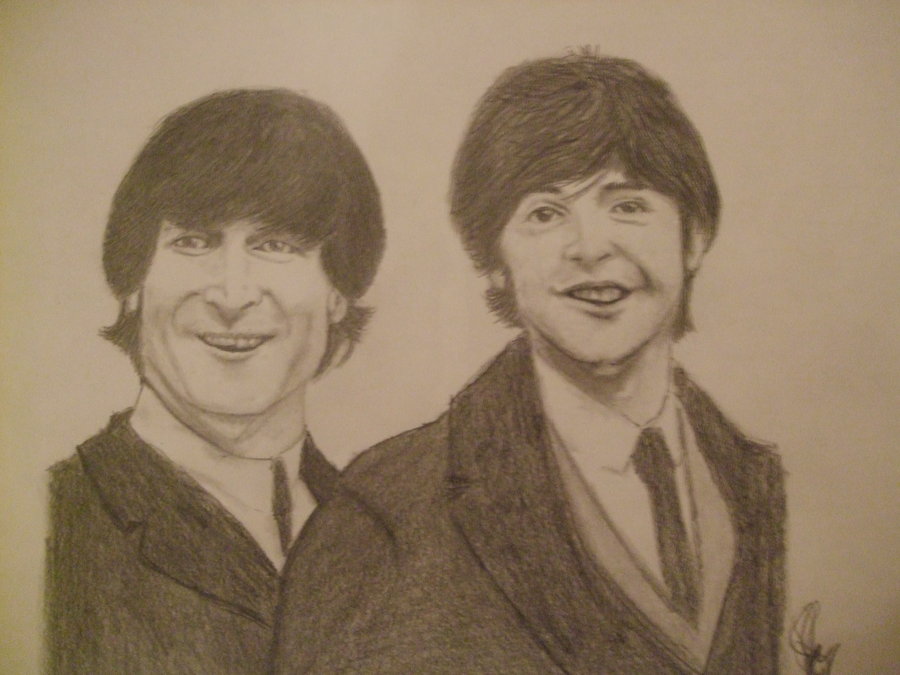
Original Beatles fan art by Thomas Hughes (www.spintoband.com)

Friday, May 6, 2011

Two Of Us


Richard Furnstein: What an opener! As the curtain rises on Let It Be, an inebriated John Lennon introduces the sad play ahead of us. His absurd babble in a shouted middle class accent suggests a good time ahead. However, the dipping quality in the songwriting and the feeling of resolution in many of the album's songs quickly dissolves this mood. 
"Two Of Us" is one of the prettier moments on this grimy posthumous collection. It's a Paul number, but is anchored by his Everly Brothers-esque harmonies with John. It's hard not hear this one as a loving tribute to the classic pair's early days as working class rabble-rousers (lifting mysterious latches, aimless joy rides). Paul insists it was written for Linda McCartney. It's a sweet sentiment, but the endless memories discussed in the lyrics point more to an old chum than a relatively new love with an American bird. I'm not buying it, Paul.  Why do you need to lie now? You are actually going to write some of the most incredible love songs ever for Ms. Eastman, including “My Love,” “Maybe I’m Amazed,” and “Every Night.” I’m sure she can handle you writing a song for your old bespectacled chum.
Robert Bunter: The idea that Paul was writing this one about Linda is patently ridiculous. The Beatles liked to look down their nose at the obsessively analytical fans who “read too much into it” and make assumptions about what was going on in their actual lives and how that affected their art. That’s all well and good when Lennon wants to spit acid at us (“Glass Onion,” “I Am The Walrus”), but if Mr. Sincere-Pursed-Lips-and-Arched-Eyebrows Paul McCartney is going to sit there and try to tell us that “Two Of Us” was not a stirring tribute to the rapidly-evaporating relationship with his adolescent partner-in-crime John Winston Lennon, well I’m just going to look him in his beautiful doe eyes and say, “No, Paul. I’m sorry but if that’s what you think this song is about, you are wrong. Let ME tell YOU about the Beatles: ‘Two Of Us’ was written about John and it’s sad and lovely. The sooner you own up to this, the sooner I’ll leave you alone. I can tell you want me to go away but I won these backstage passes fair and square from Andre Gardner at the 102.9 WMGK ‘Breakfast With The Beatles’ Trivia Buffett at Gloanburg’s Tavern in King of Prussia and I have every right to be here. By the way, do you have any real buffalo wings that aren’t vegan substitutes? I couldn’t find them on the hospitality tray.”
Richard Furnstein: Blatant lies aside. Paul does a good job of summing up the adolescent male relationship here. It’s like James Joyce delivering “Araby” in three minutes and thirty seven seconds. A triumph that would make your old pal John proud. His coming solo career would be constantly reaching for simple words to sum up the human experience, and Paul really excels at capturing young male love in this song. All gum hunting, toad licking, and stone skipping in the fading rays of summer. It’s truly gorgeous and seems devoid of the cold, heavy knit vibe that infuses much of Let It Be, tied with Beatles For Sale as their most “winter” long player. “Two Of Us” is the ray of light. The Beatles may be “going home,” but not without whistling down that long and dark path. Perfect love and a song in their hearts.
Robert Bunter: You have really phrased that beautifully. There’s not much I can add, except to invoke the bittersweet aura of pinwheels and monkeydreams: the magic of boyhood friendships and the unbearable sadness that accompanies their inevitable dissolution as the curtain falls on childhood and the stark realities of adulthood scatter yesterday’s clubhouse promises like so many shiny round marbles on the asphalt playground pavements of days gone by. Two young, laughing friends who thought things would never change, until things like women got in the way and the day dawns when these schoolyard soulmates find themselves grown up, with almost nothing remaining of their once-strong bond except a shared obsession with the greatest band that ever lived (a band I like to call: The Beatles) and the daily blog updates they write together. It’s all they have to cling to. That’s what it was like for John Lennon and Paul McCartney when they sang "Two Of Us."